Noise is a harmful or undesirable sound caused by human activity in open spaces (outdoors) or in industrial premises. We may encounter various types of noise. These include, among others:
Traffic noise – is emitted by railway, road (including county, provincial, municipal roads, as well as highways), tram, or air traffic.
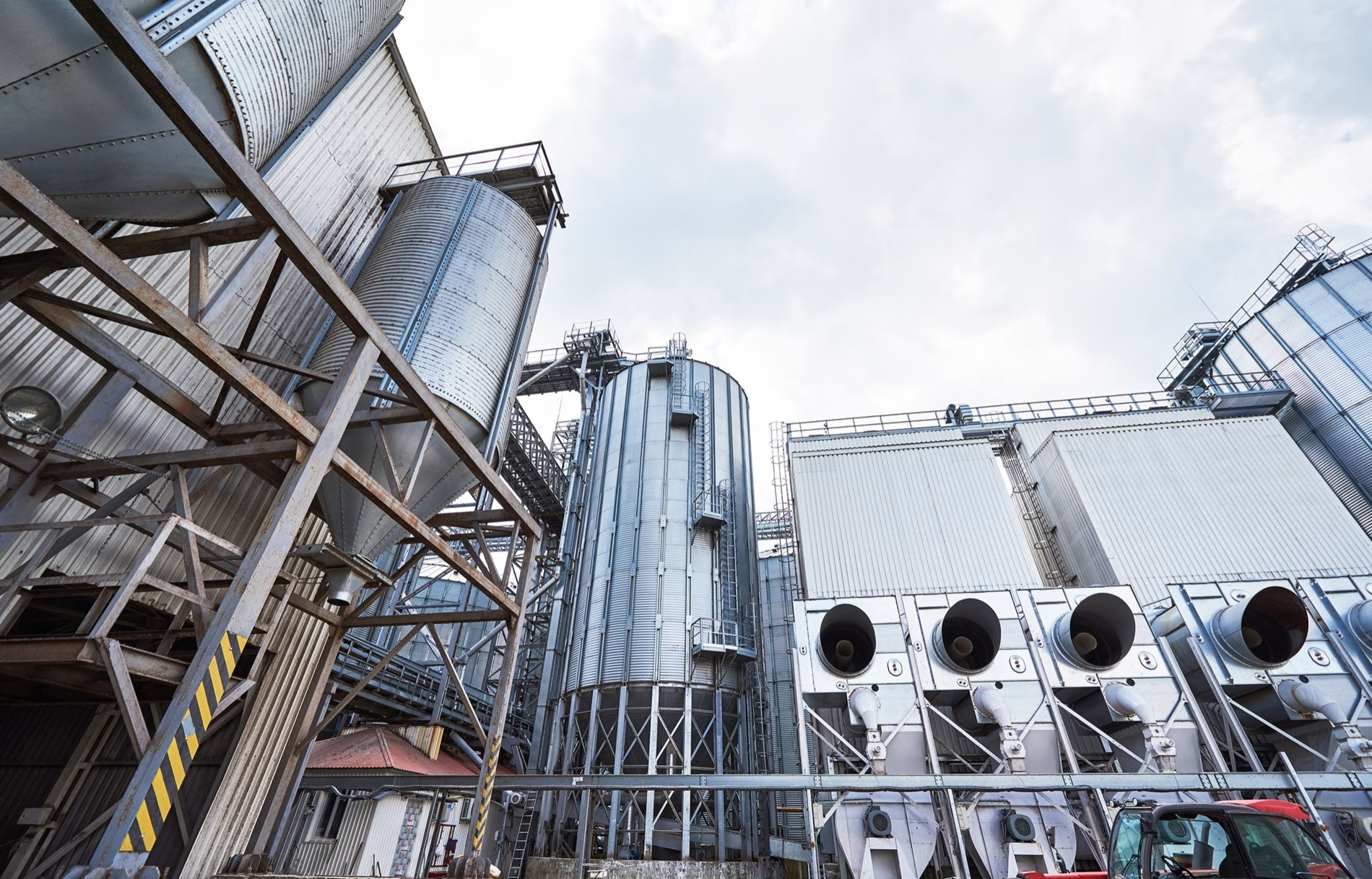
Industrial noise – its source includes, among others, the operation of industrial equipment, technological installations, fans, air conditioners, or the movement of vehicles on the project site. It occurs, for example, in industrial and manufacturing plants (such as combined heat and power plants, heating plants, wastewater treatment plants, refineries, steel mills, waste landfills), hypermarkets (air conditioning and ventilation systems), gas stations, poultry farms.
According to the Act of April 27, 2001, the Environmental Protection Law (consolidated text: Journal of Laws 2022, item 2556), noise is sound with a frequency range from 16 Hz to 16,000 Hz, which is perceived as excessively loud (usually these are sounds with an excessive intensity).
Noise, under the current regulations, is considered a pollutant. As such, it is subject to similar restrictions as other environmental pollutants, and its standards are strictly defined. To control noise levels and ensure compliance with these standards by businesses, noise measurements are carried out.
What is the purpose of noise measurements?
Noise measurements are precise studies of the noise intensity level in a specific environment. In addition to providing the ability to monitor emitted sounds, these studies also allow for identifying the sources (or source) of excessive sound intensity. This enables their elimination or reduction to a level permissible by legal standards, ensuring the best possible acoustic environment.
How should noise measurements be conducted?
Periodic noise measurements are carried out in the areas of projects for which decisions regarding permissible noise levels have been issued, or integrated permits have been granted (in such investments, installations or devices that emit noise are operated). Periodic noise measurements are conducted once every two years.
Additionally, it is important to note that meteorological conditions, which are determined at a minimum height of 3.5 meters above the ground, may pose limitations for acoustic studies. These studies cannot be conducted when the atmospheric conditions do not meet the following criteria:
Air temperature from -10°C to +50°C,
Air humidity from 25% to 90%,
Atmospheric pressure from 900 hPa to 1100 hPa,
Average wind speed up to 5 meters per second.
Furthermore, the atmospheric conditions must not differ from those specified in the operating manual of the devices used for noise measurements.
Annex 7 to the Regulation of the Minister of the Environment of September 7, 2021, on the requirements for conducting emission measurements and measurements of water consumption describes two methods of noise measurement:
Continuous method – the sound signal is recorded continuously. This method is used when it is not possible to measure the noise level emitted from individual sources, or when it is impossible to determine the time and duration of the operation of the noise sources.
Sampling method – if the noise source emits excess sound during identifiable time segments, and the emitted noise is at a level established for these segments, the sampling method can be used. Samples may last 10 seconds, 60 seconds, or 5 minutes or more.
EKO-PROJEKT - noise measurements
The laboratory provides the following services:
measurements of noise from industrial plants
measurements of noise from roads, railways, and tramways,
measurement of sound power level of machinery and equipment
noise measurements (from plants and installations) using a calculation method
In accordance with the Act of 30 August 2002 on system compatibility - OJ 2010, No. 138, item 935 as amended, the laboratory is accredited by the Polish Centre of Accreditation No. AB 1321.
Laboratory bases its research methodology on legal norms:
Reference methodology of performing periodic measurements of noise that comes from the plant or installation, except for impulse noise - Annex 7 to the Regulation of the Minister of Environment of 30.10.2014 on the requirements for the measurements of the emission and measurement of the amount of water taken (OJ 2014, item 1542)
The reference methodology for periodic measurements of noise levels in the environment in connection with the operation of roads, railway lines and tram lines and criteria for the location of measurement points - Appendix 3 to the Regulation of the Minister of Environment of 16.06.2011 on the requirements of measurement of levels of substances or energy in the environment by the manager of the road, railway, tram line, airport, port (Journal of Laws No. 11/2011, item. 824).
In addition, in order to provide the best quality of services in the laboratory, we have implemented a management system based on the PN-EN ISO / IEC 17025 (General requirements for the competence of testing and calibration of laboratories.)
To use the above measurement methodology, the laboratory uses a high-end measuring devices:, takimi jak:
Sound level meter (with preamplifier and microphone) with a first class of accuracy Svantek 955
acoustic calibrator with a first class of accuracy Rion Nc-74 and ancillary equipment:
Tripod with a place to install a microphone at a height of 4 meters
Meteorological Station Davis 6250 EU Vantage Vue
Sound registrar Zoom C6
laser rangefinder Bosch DLE 70
GPS positioning device
Moreover, in case when the background noise exceeds the level generated by the test facility or for other reasons, noise measurements are not possible, we suggest running simulations of noise propagation using a computer program LEQ Professional, which calculation algorithm is based on the ISO 9613-2 standard and on the No. 308 and 338 instructions of the Building Research Institute.
In mathematical modeling used are real sound power values of the equipment, measured during a visit to the facility.
We are looking forward to doing business with you!